Private Meditation Teacher Training & Spiritual Mentorship
A Three-Month Immersive Apprenticeship with Benjamin W. Decker
Three Private Sessions Weekly + Three-Day Immersive Retreat + Meditation Teacher Certification

Master the art of meditation. Explore the mysteries of consciousness. Deepen your spiritual practice. Learn to guide others.
Join bestselling author, meditation teacher, and interfaith spiritual mentor Benjamin W. Decker for an extraordinary three-month private apprenticeship exploring the art, science, philosophy, and transformative potential of meditation.
This is not an ordinary meditation certification program.
Drawing upon Buddhist philosophy, yogic traditions, indigenous psychologies, esoteric spirituality, comparative religion, and contemporary consciousness studies, this comprehensive apprenticeship explores meditation as both a practical discipline and a profound pathway toward self-knowledge, spiritual liberation, and personal transformation.
Learn more than ten meditation techniques, study sacred texts and contemplative philosophies, explore extraordinary states of consciousness, and develop the skills to facilitate meditation, ritual, and spiritually meaningful experiences for others.
Through personalized lectures, guided study, experiential practice, independent assignments, and supervised teaching practicums, you will cultivate your own authentic relationship with meditation while developing the knowledge, confidence, and discernment to guide others.
Your journey culminates in a three-day private meditation retreat with Benjamin, held in person whenever possible or online when necessary.
An Exceptional Private Educational & Spiritual Experience
Some journeys cannot be reduced to an online course, a weekend certification, or a collection of prerecorded lessons.
This apprenticeship offers something fundamentally different: a personalized educational relationship with an experienced meditation teacher, author, and spiritual mentor, combining the intellectual depth of advanced contemplative study with the intimacy of individual instruction and the transformative potential of sustained personal practice.
Central to this approach is the distinction between exoteric and esoteric spirituality: the publicly accessible teachings, practices, and expressions of a tradition, and the deeper, sometimes initiatory or restricted dimensions of its spiritual life. Understanding these distinctions helps us approach sacred traditions with greater knowledge, discernment, and respect.
The apprenticeship also explores the difference between open practices and closed or restricted practices, and between cultural appreciation and cultural appropriation. Students learn to recognize the importance of egregores, lineage, community, context, permission, and the boundaries established by the traditions they study.
Rather than treating the world's spiritual traditions as a collection of interchangeable techniques, this apprenticeship invites students to a more sophisticated languaging that will allow them (and their students) to understand their distinct histories, meanings, and contributions while exploring opportunities for respectful dialogue, mutual learning, and spiritual growth.
Rather than simply learning techniques, you will study the philosophies behind them, experience their application firsthand, investigate the deeper dimensions of consciousness, and develop the practical skills to guide others.
What distinguishes this apprenticeship is the depth of personal attention and the integration of study, experience, and mentorship.
Every week, you will work directly with Benjamin through three distinct private sessions:
an illustrated lecture and instructional presentation,
a guided study session featuring selected texts and contemplative exercises,
and an experiential practice session devoted to meditation and supervised development.
Your learning extends beyond these sessions through a personalized curriculum, assigned readings, independent meditation practice, reflective exercises, and progressively advanced teaching practicums.
Throughout the journey, the curriculum is adapted to your interests, background, experience, and aspirations, while retaining a consistent, complete, arc.
You will not simply complete a training program. You will cultivate a body of knowledge, an effective contemplative practice, an authentic teaching voice, and a deeper understanding of your relationship with consciousness, spirituality, and the world.
This is an investment in and initiation into new dimensions in your education, your spiritual development, and your capacity to serve others through meditation.
Beyond Mindfulness: A Deeper Understanding of Meditation
Why do we meditate?
For some, meditation offers relaxation, emotional balance, or greater self-awareness. For others, it is a sacred discipline through which consciousness is explored, spiritual wisdom is cultivated, and liberation or enlightenment is pursued.
Across religious and esoteric traditions, meditation has also been associated with mystical experiences, expanded perception, and extraordinary spiritual capacities.
This apprenticeship explores the diversity of these perspectives while asking deeper questions:
This training explores the diversity of these perspectives while asking deeper questions:
What is consciousness?
How are thoughts, identities, and beliefs conditione?
What distinguishes spiritual experience from spiritual interpretation?
How do we recognize unconscious influencers and develop greater freedom in our lives?
How do we confront the unconscious fears, egregores, and belief systems we are unconsciously committed to?
What makes someone qualified to guide another person through contemplative spiritual development practice?
This inquiry also extends beyond the boundaries of any single tradition. Through comparative religious studies, we explore the similarities, differences, histories, and philosophical perspectives of the world's religions. Through collaborative interfaith study, we ask an additional question: How might these traditions, while remaining distinct, enrich, support, and learn from one another?
Just as friends and loved ones bring different experiences, perspectives, gifts, and strengths into our lives, the variety of global spiritual traditions can offer one another meaningful insights without needing to become identical. A relationship of mutual respect does not require agreement on every belief. It asks instead what we can learn from one another, how we can support one another, and what wisdom might emerge through sincere encounter. The egregores of each and every spiritual tradition can be viewed as organs of the spiritual collective body, each serving a purpose. Collective awakening is about the recognition and embodiment of that purpose, as the current expressions of all things are largely reactive and unconscious, and therefore we will explore the concept of awakened or illuminated versions of each egregore or collective group you find yourself consciously or unconsciously engaged with or linked to.
This approach recognizes interfaith engagement not merely as an exercise in comparison or tolerance, but as an opportunity for reciprocity, collaboration, mutual enrichment, and shared service. Thereby, we find that sacred realization that delivers the miracle of a transformed perspective, and places where there was disharmony may become harmonious, places of contention can become places of curisoity, and areas of exploitation can become places of justice - within oneself and gradually attuned to community and social levels of health and betterment of one’s own life experience, and not only not at the expense of others, but to actually exist consciously as a generative being, fully in touch with the human experience of today, infused with the light of highher knowing.
Meditation becomes more than a technique. It becomes a means of making the unconscious conscious, examining inherited limitations, cultivating wisdom and compassion, and participating more intentionally in the creation of our lives.
Weekly Cadence of Your Personalized Apprenticeship

Your apprenticeship follows a consistent weekly rhythm of three private, 45-minute sessions, each with a distinct purpose. Together, these sessions integrate intellectual understanding, reflective inquiry, and direct contemplative experience.
Weekly Session One: Visual Lecture & Instruction
45 Minutes | Private Teaching & Presentation
Each week begins with a lecture and visual presentation led by Benjamin.
Through illustrated teachings, structured presentations, demonstrations, and discussion, you will explore the week's central subjects, drawing upon contemplative traditions, sacred texts, philosophy, psychology, and contemporary spiritual thought.
These sessions provide the intellectual and philosophical foundation for the week's study and practice.
weekly Session Two: Guided Study & Contemplative Inquiry
45 Minutes | Textual Study, Exercises & Reflection
Deepen your understanding through interactive study sessions centered on selected readings, specific passages from foundational texts, guided exercises, and reflective prompts.
Rather than simply discussing what a text says, you will examine its meaning, historical and spiritual context, practical applications, and relationship to your own lived experience.
Sessions may include close reading, comparative religious study, contemplative writing, philosophical inquiry, and structured self-discovery exercises designed to translate knowledge into understanding.
weekly Session Three: Guided Meditation & Experiential Practice
45 Minutes | Direct Practice & Supervised Development
Bring the week's teachings into direct experience through guided meditation, breathwork, visualization, contemplative exercises, and other experiential practices.
These sessions provide opportunities to deepen your personal meditation practice, explore different techniques, and integrate the philosophical concepts introduced earlier in the week.
As your training progresses, guided practice sessions increasingly incorporate student-led meditation facilitation and supervised practicums, allowing you to practice teaching, receive personalized feedback, and refine your skills as an instructor.
Independent Study & Personal Practice
Between private sessions, you will engage in assigned readings, meditation practice, reflective journaling, contemplative exercises, and teaching preparation.
These independent activities are an essential part of the apprenticeship, allowing you to integrate the material into your daily life while developing the discipline and confidence necessary for effective meditation instruction.
The Curriculum
I. Foundations of Meditation, Contemplative Spirituality & Interfaith Understanding
Explore meditation as a practice, philosophy, spiritual discipline, and means of personal transformation while establishing an ethical foundation for studying and engaging with diverse wisdom traditions.
The history and evolution of meditation across cultures
Buddhist, Hindu, Christian, and other contemplative traditions
Modern spirituality and the interfaith worldview
Indigenous psychologies and traditional understandings of consciousness
Comparative religious studies: understanding similarities, differences, and distinct theological perspectives
Collaborative interfaith study: exploring how different traditions can learn from, support, and enrich one another
Interfaith friendship, reciprocity, and mutual service
Exoteric and esoteric dimensions of religion and spirituality
Open practices versus closed, initiatory, and restricted practices
Cultural appreciation versus cultural appropriation
Lineage, authorization, cultural context, and responsible participation
Respecting the integrity and boundaries of living spiritual traditions
Meditation posture, breath awareness, and foundational anatomy
Concentration, mindfulness, contemplation, and awareness
Technique versus intention
Intention versus impact
Preparation, purification, and integration
Ethics, cultural sensitivity, and responsible spiritual leadership
Students will develop the ability to engage with diverse contemplative traditions thoughtfully, recognizing both the universal human questions that connect spiritual communities and the particular histories, commitments, and practices that make each tradition unique.
II. Buddhist Philosophy & the Gradual Path to Enlightenment
Study foundational and advanced Buddhist teachings through contemplative practice, philosophical inquiry, and traditional texts.
The Four Noble Truths and Noble Eightfold Path
Refuge, compassion, and the Three Jewels
The Heart Sutra and the perfection of wisdom
Emptiness (śūnyatā) and dependent origination
The Gradual Path to Enlightenment (Lamrim)
Renunciation, bodhicitta, and the aspiration toward enlightenment
Śamatha (calm abiding) and vipaśyanā (insight)
The four jhānas and progressive meditative absorption
The six higher knowledges (abhiññā)
Extraordinary powers (iddhi) in Buddhist contemplative literature
The relationship between meditative attainment, ethical conduct, wisdom, and liberation
Students will examine these teachings within their historical and philosophical contexts, including their relevance to contemporary contemplative practice.
III. Meditation Techniques & Practical Mastery
Develop a versatile repertoire of more than ten meditation practices through direct experience, personalized instruction, and independent practice.
Techniques include:
Mindfulness of breathing
Body scan meditation
Loving-kindness (mettā) meditation
Compassion meditation
Single-pointed concentration
Open awareness meditation
Mantra meditation
Visualization meditation
Analytical and contemplative meditation
Walking meditation
Yoga Nidra
Guided imagery and deep relaxation
Contemplative prayer
Self-inquiry meditation
Intention-based and integrative meditation
Learn to understand the purpose, structure, benefits, limitations, and appropriate applications of different techniques, while developing the flexibility to work with students of diverse backgrounds and experience levels.
IV. Meditation, Consciousness & Liberation from Conditioning
Explore meditation as a means of recognizing unconscious patterns, examining inherited belief systems, and cultivating greater personal freedom.
Making the unconscious conscious
Religious conditioning and spiritual deconstruction
Social programming, political identity, and collective belief systems
Unconscious bias and limiting beliefs
The relationship between identity, attachment, and suffering
Recognizing and questioning internalized narratives
Egregores and collective thoughtforms within esoteric traditions
Disengaging from harmful patterns of identification
Consciously participating in beneficial communities and collective systems
Cultivating autonomy, discernment, compassion, and personal responsibility
This module approaches meditation as a practical means of developing self-awareness and intentionally engaging with the beliefs, relationships, and structures that shape our lives.
V. Extraordinary States, Siddhis & Esoteric Exploration
Explore traditional accounts of extraordinary meditative capacities and the relationship between contemplative practice, mystical experience, and esoteric spirituality.
Subjects include:
Siddhis in the Yoga Sutras of Patañjali
The four jhānas and their relationship to advanced concentration
The six higher knowledges in Buddhist literature
Traditional accounts of clairvoyance, telepathy, and extraordinary perception
Astral projection and out-of-body experiences
Lucid dreaming and dream practices
Remote viewing and parapsychological research
Esoteric theories of subtle consciousness and spiritual perception
The distinction between extraordinary experiences and spiritual liberation
Discernment, psychological grounding, and responsible interpretation
These subjects are explored through traditional teachings, historical perspectives, experiential inquiry, and contemporary research, with clear distinctions between spiritual claims, subjective experiences, and scientifically established findings.
VI. Energy Work, Ritual & Ceremonial Practice
Explore the intersection of meditation, spiritual symbolism, energy-based traditions, and intentional ceremonial practice.
Reiki and contemporary energy-healing traditions
Chakras and subtle-body systems
Energy awareness, visualization, and intentional practice
Sacred space and altar preparation
The relationship between the body, home, and altar as interconnected spaces of practice
Ritual structure and ceremonial mechanics
Invocation, mantra, visualization, and contemplative symbolism
Preparation and intention-setting
The use of sacred objects, sound, and symbolic gestures
Opening, facilitating, and closing ceremonial experiences
Spiritual discernment and ethical considerations
Integration following ritual and spiritually significant experiences
Students will explore the purpose and structure of ritual while learning to design meaningful contemplative experiences grounded in respect, intention, cultural understanding, and personal responsibility.
Special attention is given to distinguishing openly accessible contemplative practices from closed, restricted, or initiatory traditions. Students will examine how sacred practices are transmitted, the significance of lineage and authorization, and the responsibilities involved in learning from spiritual communities beyond one's own.
Through this study, students will develop a framework for distinguishing cultural appreciation from cultural appropriation, honoring the integrity of living traditions while exploring respectful forms of interfaith collaboration and spiritual exchange.
The goal is not to claim every tradition as our own, but to learn how to encounter one another's wisdom with sincerity, humility, discernment, and mutual respect.
VII. Spiritually Transformative Experiences & Integration
Learn to approach profound, unusual, or challenging spiritual experiences with curiosity, compassion, and discernment.
Mystical and spiritually transformative experiences
Altered states of consciousness
Spiritual emergence and challenging contemplative experiences
Symbolism, archetypes, and meaning-making
Psychological and spiritual interpretations of experience
Preparation for intensive meditation and retreat
Integration practices and reflective inquiry
Maintaining grounding and healthy boundaries
Recognizing when professional mental health support may be appropriate
Translating insight into meaningful everyday action
The emphasis is on supporting thoughtful integration rather than imposing particular interpretations or beliefs.
VIII. The Art of Meditation Teaching & Spiritual Leadership
Develop the practical competencies necessary to guide meditation responsibly and confidently.
The ethics and responsibilities of meditation instruction
Developing your authentic teaching voice
Designing and sequencing guided meditations
Facilitating individual and group sessions
Adapting practices to different needs and experience levels
Creating inclusive and psychologically considerate environments
Working with intention, attention, pacing, and silence
Understanding the distinction between technique and intention
Evaluating intention versus actual impact
Recognizing the limits of one's training and professional scope
Supporting reflection and integration
Designing workshops, classes, and contemplative experiences
Establishing a sustainable personal teaching practice
Throughout the apprenticeship, you will transition progressively from receiving meditation instruction to facilitating practices yourself.
Your Three-Month Journey
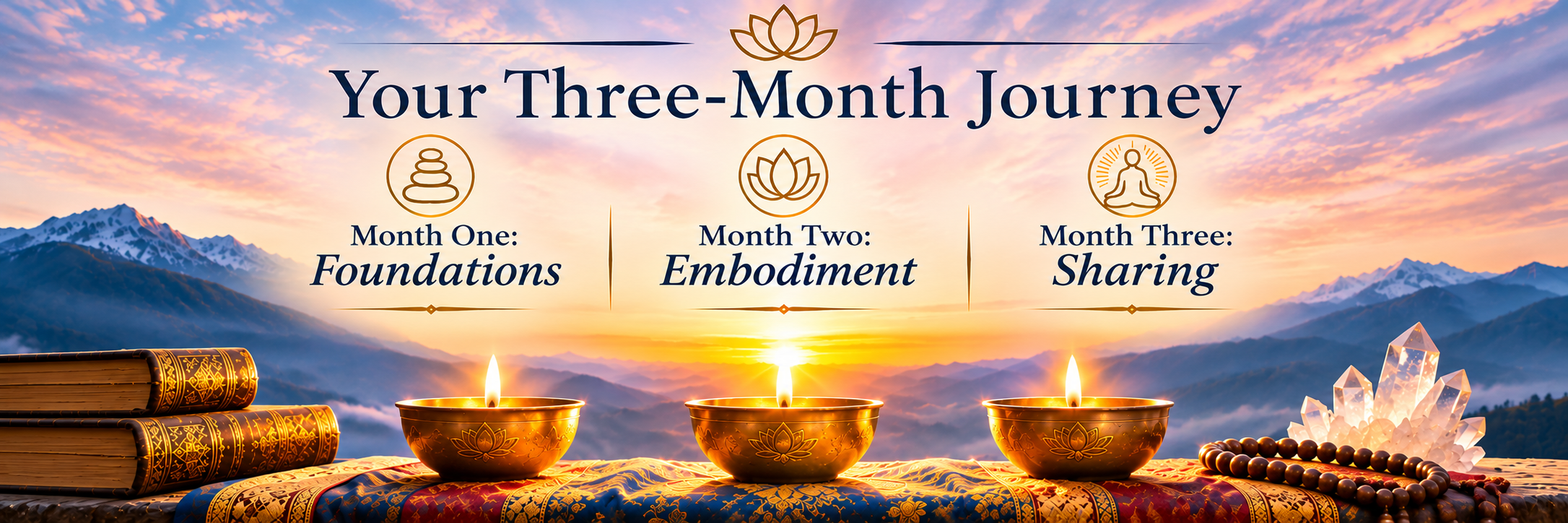
Month One: Foundations, Awareness & Personal Practice
Establish a strong personal practice while developing a foundational understanding of meditation, interfaith spirituality, contemplative philosophy, and the relationship between consciousness and conditioning.
Explore multiple meditation techniques, begin your reading assignments, and develop a personalized practice plan.
Month Two: Depth, Consciousness & Spiritual Exploration
Deepen your study of Buddhist philosophy, the Heart Sutra, Lamrim, jhānas, extraordinary states, esoteric traditions, energy work, and ritual.
Engage in increasingly sophisticated meditation practices while examining the relationship between spiritual experience, interpretation, ethics, and integration.
Month Three: Teaching, Facilitation & Embodied Leadership
Develop your instructional skills through guided teaching exercises, supervised practicums, meditation design, feedback, and assessment.
Refine your teaching voice, deepen your personal practice, and prepare to facilitate meaningful meditation experiences for others.
The three-month experience culminates in a private, three-day meditation retreat and final teaching assessment.
Foundational Reading & Study
Your apprenticeship incorporates selected readings from traditional contemplative literature, Buddhist philosophy, interfaith spirituality, modern meditation instruction, psychology, and esoteric philosophy.
Core texts include:
Practical Meditation for Beginners — Benjamin W. Decker
The Yoga Sutras of Patañjali
Telepathy and the Etheric Vehicle — Alice A. Bailey
Egregores: The Occult Entities That Watch Over Human Destiny — Mark Stavish
The Tibetan Book of the Dead (Bardo Thödol)
Toward a True Kinship of Faiths — His Holiness the 14th Dalai Lama
The Initiates of the Flame — Manly P. Hall
The Mature Mind — H. A. Overstreet
Additional study may include the Heart Sutra, Buddhist discourses on meditative absorption and the six higher knowledges, Lamrim literature, Tibetan Buddhist contemplative teachings, comparative religious studies, developmental psychology, and selected contemporary research on meditation, consciousness, and spiritually transformative experiences.
Reading assignments are tailored to each student's interests, background, experience, and personal and professional aspirations.
Supervised Practicum & Teaching Development
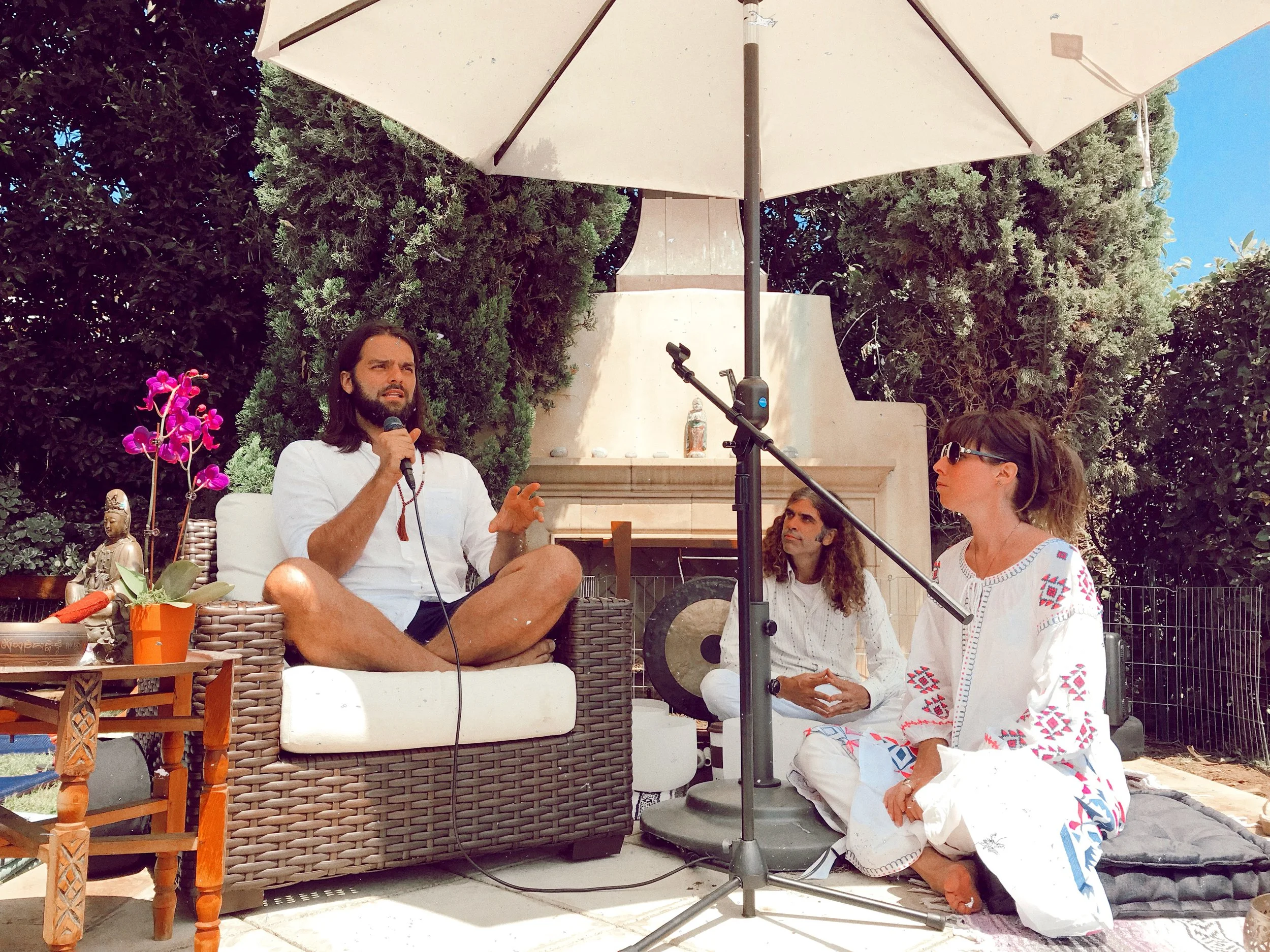
A central component of this apprenticeship is the transition from meditation practitioner to meditation instructor.
Throughout the program, you will progressively develop your ability to design, guide, and evaluate meditation experiences.
Your practicum may include:
Writing original guided meditation scripts
Designing meditation sessions for specific intentions and audiences
Practicing verbal instruction, pacing, and the use of silence
Facilitating meditations during private mentorship sessions
Recording guided meditations for review and feedback
Leading meditation experiences for volunteer participants
Reflecting on participant feedback and teaching outcomes
Demonstrating ethical judgment and appropriate professional boundaries
Completing a final supervised teaching assessment
Benjamin will provide individualized feedback to help you develop an authentic, effective, and responsible approach to meditation instruction.
The Three-Day Private Meditation Retreat

The rite of passage. A three month journey crafted for you, using the cadence of three full lunar cycles now complete, we mark the transition and culmination of your three-month apprenticeship.
Your journey concludes with an immersive three-day meditation retreat designed to integrate everything you have studied, practiced, and experienced. We will take an inventory of the previous three months, we will practice what we have learned, we will look to the future with hope and inspiration, and set intentions for how to manifest it.
Each day includes 4+ hours of personalized instruction, guided practice, and direct teaching with Benjamin W. Decker, complemented by a thoughtfully structured program of independent meditation, contemplative study, personal rituals, reflection, and integration. The entire retreat will be designed around your preferences, while effectively achieving the necessary ordinance of recapping, embodying, integrating, and casting a vision for the future.
Retreat experiences may include:
Extended meditation and contemplative practice
Personalized instruction and spiritual mentorship
Guided meditation, breathwork, and visualization
Ritual and ceremonial practices
Intuitive psychic development practice
Independent spiritual exercises and personal rituals
Periods of contemplative silence and self-reflection
Applied therapeutic energywork
Supervised meditation facilitation and teaching practicums
Philosophical discussion and spiritual inquiry
Final teaching assessment and individualized feedback
Integration and planning for continued spiritual development
The retreat is designed to balance direct mentorship, independent exploration, and an initiation designed for you, providing both the guidance and personal space, and elements uniquely necessary for meaningful personalized contemplation and integration of the three month journey.
Whenever possible, the retreat will take place in person with Benjamin at a mutually agreed-upon location. If an in-person retreat is not feasible, the experience will be adapted to a live, interactive virtual format.
Retreat instruction and mentorship are included in the program investment. Travel, accommodations, meals, venue expenses, and other retreat-related costs are separate.
What's Included:
Three private 45-minute sessions per week throughout the three-month program, in three consistent formats of:
First Weekly Session: Visual presentations and personalized lectures
Second Weekly Session: Guided textual study with reflective prompts, exercises, and discussion
Third Weekly Session: Guided meditation and experiential practice sessions
A personalized, interfaith interdisciplinary meditation teacher training curriculum
Direct instruction and spiritual mentorship from Benjamin W. Decker
Study of contemplative texts, sacred literature, and spiritual philosophies
Instruction and practice in more than 15 meditation techniques
Exploration of Buddhist philosophy, consciousness, esotericism, and ritual
Personal meditation assignments and reflective journaling
Supervised meditation teaching practicums
Individualized feedback on facilitation and instructional development
Development of meditation scripts and teaching materials
Ongoing evaluation of knowledge, practice, and teaching competency
A three-day private meditation retreat with 4+ hours of direct instruction and practice each day
Certificate of Completion upon fulfillment of program requirements
Eligibility for independent Meditation Teacher Certification upon successful assessment
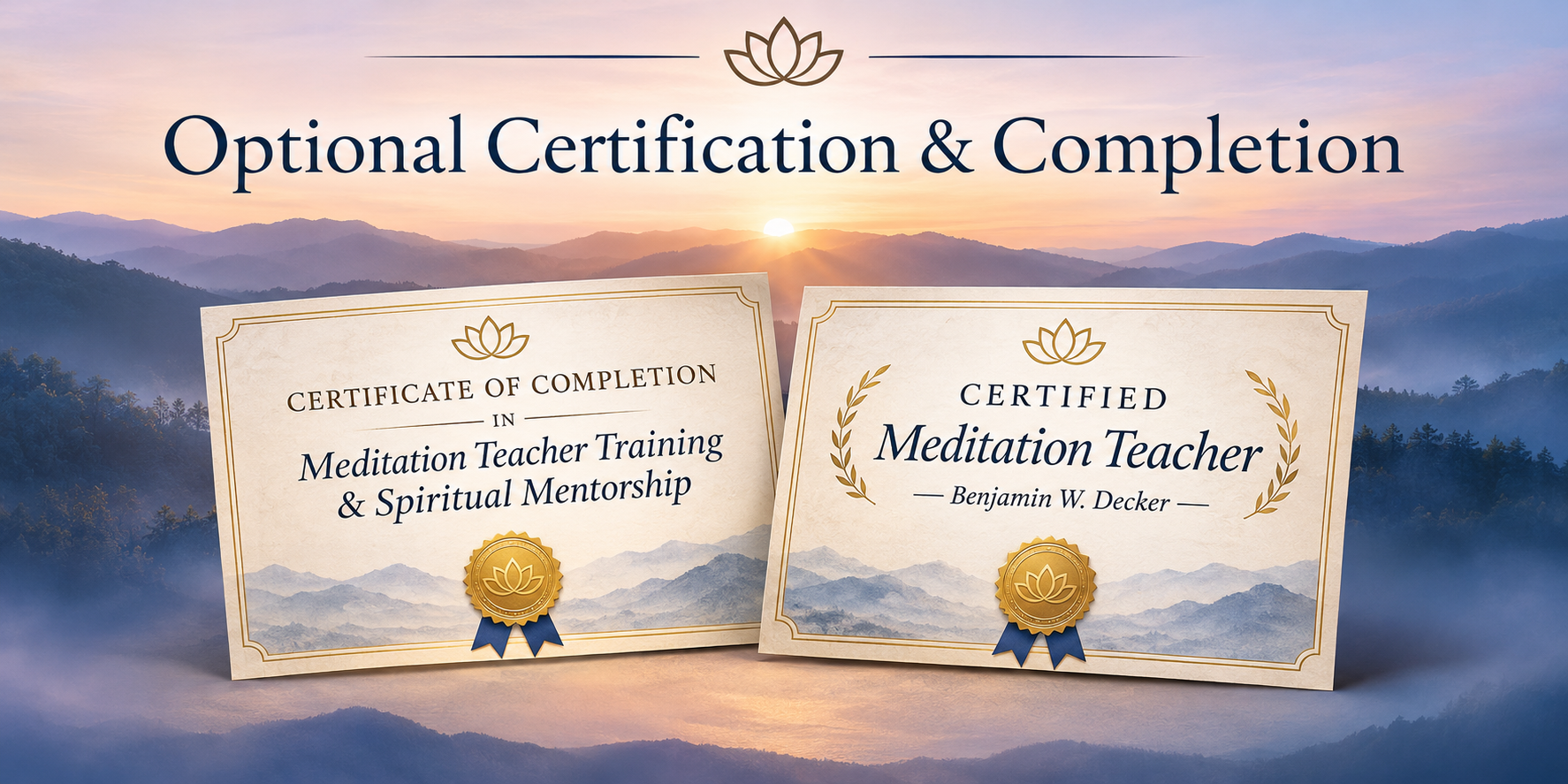
Optional Certification & Completion:
This apprenticeship is designed to support both personal spiritual development and the practical competencies required for responsible meditation instruction.
Students who successfully complete the program's study, practice, participation, and practicum requirements receive a:
Certificate of Completion in Meditation Teacher Training & Spiritual Mentorship
Students who additionally demonstrate the required knowledge, ethical awareness, personal practice, and teaching competencies through a final assessment may receive the designation:
Certified Meditation Teacher — Benjamin W. Decker
Certification is based on demonstrated competency rather than attendance alone.
This credential is independently issued by Benjamin W. Decker and does not represent external academic accreditation, professional licensure, or religious lineage authorization.
Who This Experience Is For:
This private apprenticeship is designed for aspiring meditation teachers, experienced spiritual practitioners, yoga instructors, wellness professionals, contemplative students, interfaith leaders, and individuals seeking an immersive exploration of meditation and consciousness.
Whether you wish to teach meditation professionally, deepen your existing spiritual practice, integrate contemplative techniques into your work, or explore the deeper philosophical and esoteric dimensions of meditation, your apprenticeship will be tailored to your unique goals.
No particular religious affiliation or spiritual belief system is required.
All backgrounds and levels of experience are welcome.
About Benjamin W. Decker

Benjamin W. Decker is a bestselling author, meditation teacher, esotericist, and interfaith minister whose work bridges traditional contemplative wisdom and contemporary spirituality.
He is the author of Practical Meditation for Beginners, Meditations on Christ, Modern Spirituality, and Daily Mindfulness.
His teaching draws upon years of experience in meditation instruction, retreat facilitation, spiritual mentorship, interfaith studies, and contemplative practice.
Influenced by Buddhist philosophy, yogic traditions, esoteric studies, and the wisdom traditions of the world, Benjamin offers an inclusive approach to spiritual education grounded in compassion, curiosity, personal responsibility, and the pursuit of wisdom.
His work encourages students not merely to adopt spiritual teachings, but to examine them, experience them thoughtfully, and develop an authentic contemplative practice.
Your Investment
$20,000 USD | Three-Month Private Apprenticeship
This exclusive program includes personalized instruction, guided study, experiential practice, supervised teaching practicums, spiritual mentorship, and a culminating three-day private meditation retreat.
Every apprenticeship is individually tailored to the student's experience, interests, and aspirations.
Limited partial scholarships, flexible payment arrangements, and work-trade opportunities may be available upon request. All arrangements are considered individually.
Travel, accommodations, meals, and other retreat-related expenses are separate.
Begin Your Journey
Meditation is more than something we practice. It is a way of understanding ourselves, examining consciousness, cultivating wisdom, and transforming how we engage with the world.
This apprenticeship is an invitation to go beyond the familiar, explore the profound possibilities of contemplative life, and develop the skills to share meditation with others.
Deepen your practice. Expand your understanding. Discover your voice as a teacher.
Applications are welcome for the Private Meditation Teacher Training & Spiritual Mentorship with Benjamin W. Decker.
Enrollment and payment arrangements are coordinated individually following acceptance.
This program provides spiritual and educational instruction, not medical or psychological treatment. Exploration of metaphysical concepts, extraordinary abilities, and energy-based traditions does not constitute a guarantee of supernatural experiences or therapeutic outcomes. The program does not confer authorization to teach restricted religious practices or provide regulated professional services.